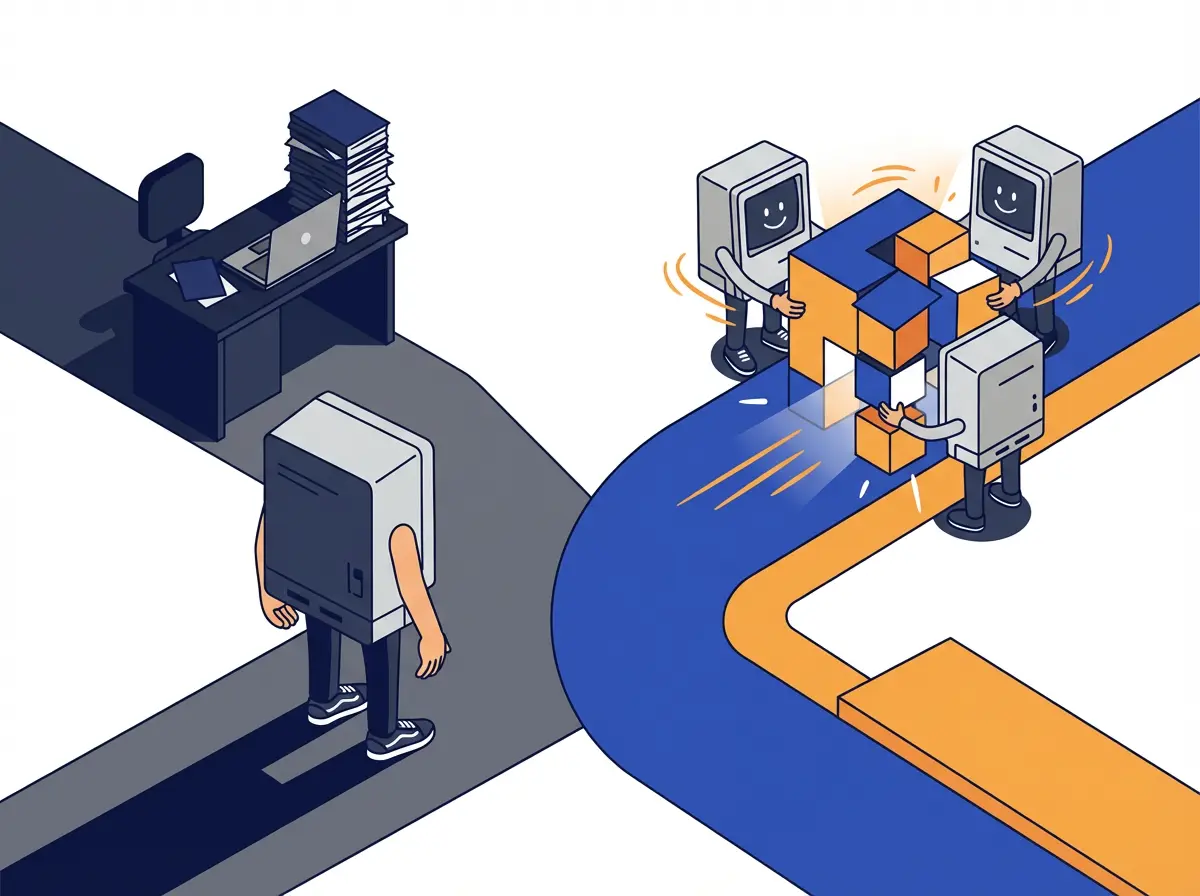
Every startup founder eventually stares at the same spreadsheet. You've got $500k in the bank, a product that needs to ship yesterday, and a single question: "Do I hire a senior dev, or do I find a partner?"
Most founders look at the salary number first. They see $140,000 or maybe $160,000 if they're in a competitive market like Denver or SF, and then they compare that to an agency or a dedicated team. On paper, the monthly retainer for a partner usually looks "more expensive" than a single head in a seat, and that's where most of the conversations stop.
The problem is that the spreadsheet usually lies. Or, more accurately, it only tells the part of the story that's easy to calculate.
I've sat on both sides of this table. I've been the "first hire" at a growing shop and I've been on the partner founders call when that first hire doesn't work out, and the truth is, the cost of a developer isn't just their salary. It's the management obligation you're taking on when you should be building a company.
The Hidden Costs of the "First Hire"
When you hire a full-time engineer, you aren't just buying code. You're buying a management obligation that starts long before they even write their first line of JavaScript.
If you use a recruiter, that's a 20-30% fee, sometimes $30k+ upfront, and if you do it yourself, that's 40-60 hours of your own time spent screening resumes and doing technical interviews instead of talking to your customers. Even after they're hired, you've got taxes, health insurance, 401k matching, equipment, and all the SaaS seats they need to actually do the job. That $140k salary is actually nearly $180k flowing out of your bank account.
And then there's the ramp time. No matter how senior they are, it takes a few months for a new hire to truly understand your vision, your tech stack, and your customers. You're paying 100% of the cost for about 40% of the output during that window, and if your one senior dev gets sick, goes on vacation, or gets a better offer, your product stops.
But the cost that never shows up on the spreadsheet is your own attention. Every hour you spend writing a job description, sitting in a technical interview, or explaining your product vision to a new hire is an hour you're not spending with customers, not closing deals, not thinking about your roadmap. Founders underestimate this because they're used to working hard, and managing an engineer doesn't feel like "extra work" until you're three months in and realize you haven't talked to a single user in weeks.
There's also a thing that happens when you make your first engineering hire that nobody warns you about: you become responsible for someone's career. They're going to want growth, mentorship, architectural input, and a sense of direction. If you're a non-technical founder, you're going to struggle to give them that, and if you ARE a technical founder, you're going to find yourself pair-programming when you should be fundraising. Either way, the management tax compounds in ways the spreadsheet can't predict, and it's usually the thing that makes founders say "I wish I'd done this differently" eighteen months later.
The Dedicated Team Alternative
When we talk about an "embedded partnership" at House of Giants, we're talking about something a bit different than a traditional agency. An agency is usually a vending machine where you put in a ticket and you get a feature, but an embedded partnership gives you a specialized team that acts as your internal engineering arm without the overhead.
The math looks different here because you're paying for availability and momentum, not just a head in a seat. A dedicated team brings their own process, their own tooling, and their own internal communication rhythm, so they start shipping on day one. You also get a mix of skillsets. One senior dev is rarely an expert in DevOps, frontend architecture, and UX all at once, but an embedded team gives you access to the right specialist for the task at hand.
Plus, you can dial the heat up when you're pushing for a launch and dial it back when you're in maintenance mode. You can't exactly "partially" lay off a full-time hire when the roadmap slows down.
What Week One Actually Looks Like
I think it helps to make this concrete, because the difference between these two paths is sharpest right at the beginning.
Week one with a new hire, even a great one, looks like this: you're setting up their laptop, getting them access to repos and Slack channels, walking them through the codebase, explaining why that one service is structured weird (because it is, and you know it, but there's a reason). They're reading documentation, asking good questions, maybe fixing a small bug to get their feet wet. That's a good week one. A bad week one is when the onboarding docs don't exist yet because you never had time to write them, so you're doing the whole thing live, and every question pulls you out of whatever you were supposed to be doing that day.
Week one with a dedicated team looks different because they already have a process for absorbing a new codebase. They've done this dozens of times. The first few days are a structured discovery where they audit your stack, identify the quick wins and the landmines, and come back to you with a realistic picture of where things stand. By the end of the week, they're shipping. Not because they're faster than your hypothetical hire, but because they've built the muscle of starting fast, and they don't need you to hold their hand through it.
That difference in week one sets the tone for everything that follows. The hire is still learning your system at month two. The team is already three sprints deep.
The Actual Cost Comparison
I've done this math enough times with enough founders that I can give you a realistic picture. These numbers aren't theoretical, they're pulled from real conversations with early-stage companies in the $2M-$10M range.
Hiring a senior full-stack engineer in-house:
| Line Item | Annual Cost |
|---|---|
| Base salary (senior, US market) | $140,000 - $165,000 |
| Health insurance + benefits | $15,000 - $25,000 |
| Payroll taxes (FICA, FUTA, state) | $12,000 - $15,000 |
| Equipment, SaaS seats, office | $5,000 - $10,000 |
| Recruiter fee (if used, amortized Y1) | $28,000 - $40,000 |
| Year 1 total | $200,000 - $255,000 |
| Year 1 effective output (3-month ramp) | ~75% productivity |
And that's assuming the hire works out. If they leave at month 8, which happens more than anyone likes to admit, you're back to zero with $150k+ spent and nothing to show for it except whatever code they wrote that you now have to figure out how to maintain.
A dedicated development team:
| Line Item | Annual Cost |
|---|---|
| Monthly retainer ($8k-$20k/mo) | $96,000 - $240,000 |
| Ramp time | ~2 weeks, not months |
| Recruiting cost | $0 |
| Benefits, taxes, equipment | $0 (that's on us) |
| Scaling flexibility | Dial up or down monthly |
| What you get | A senior team's skillsets, not 1 generalist |
Depending on where you land in that range, the sticker price can still run higher than a single salary, I'm not going to pretend otherwise. But you're comparing one person who needs three months to get productive against a team that ships in week two. And if you factor in the recruiting risk, the management time you're burning, and the fact that your one hire is a single point of failure for your entire product, the math starts to look a lot different.
The founders I work with who've done both usually say the same thing: "I wish I'd started with the team and hired in-house once I knew exactly what I needed."
That's the part that I think gets lost in these conversations. A dedicated team isn't a forever commitment, or at least it shouldn't be. The good ones actually help you figure out when it's time to hire in-house, because they can see your product maturing and they know what kind of engineer you'll eventually need. After six months of working together, your team knows your codebase inside and out, they've documented the architecture decisions, and they can tell you "you need a senior React dev who's comfortable with this specific state management pattern" instead of you guessing from a job board. The transition from partner to in-house hire should feel like a graduation, not a breakup, and the team you worked with should be able to hand off cleanly because they built the system to be maintainable by someone who isn't them.
If a dev partner makes it hard to leave, that's a red flag, not a business model.
What About Freelancers?
This is the third option that always comes up, and I get it. Freelancers look great on paper. You find someone on Upwork or through your network, you pay them for exactly the hours you need, and there's no long-term commitment.
The problem is that freelancer relationships tend to break down at exactly the moment you need them most. When you're pushing for a launch, when the scope gets complicated, when you need someone who understands the full picture of your product and not just the ticket they were assigned. Freelancers optimize for their own schedule, which is completely fair, but it means your critical-path feature might be sitting behind someone else's deadline.
I've also seen a pattern where founders cobble together two or three freelancers to cover different specialties, frontend here, backend there, maybe a DevOps person on retainer, and suddenly they're spending half their week coordinating people who've never met each other. You became an engineering manager without meaning to, and that's exactly the job you were trying to avoid.
Freelancers work great for defined, isolated tasks. Logo design. A one-off integration. An audit. They don't work great as your core engineering strategy when you're trying to build something complex.
When should you actually hire in-house?
A dedicated team isn't always the right move. I certainly won't lie to you there.
If your product is your core R&D, if you're building a new type of database or a proprietary AI model where the code itself is the intellectual property and the primary value of the company, you need those people in the building. You need them dreaming about the architecture at 2 AM.
But if you're building a product to solve a problem for users, i.e. a SaaS platform, a high-end marketplace, or a complex fintech tool, your value isn't in the act of hiring engineers. Your value is in how fast you can iterate based on what your customers want. A dedicated team isn't an "outsourced" expense, it's a way to buy back your own time as a founder.
I spoke with a buddy of mine today who illustrated the problem masterfully. He's building a game, and has been doing it all himself up to this point. He's now far enough along that he has to bring in help. Folks for sound design, graphics assets, things like that. Should be no problem right? Who doesn't want to build a game? Unfortunately the churn for my buddy has been real. A person here or there that talks a big game but can't deliver. Someone promising results, but providing none of what was spec'd out. It's a human problem, and it's a hard one to solve. ESPECIALLY in the age of AI where, as a busy founder, you're going to have a real tough time differentiating a prospective hire's AI slop, from high quality work.
This part keeps me up at night on behalf of the founders I work with. The technical skills are actually the easy part to evaluate. What's hard is figuring out whether someone is going to listen. Whether they're going to internalize your vision or just nod along and build what they were going to build anyway. I've had conversations with founders who fired their previous dev shop or their in-house hire not because the code was bad, but because the person just wouldn't listen. They had their own ideas about how the product should work, and they kept building that version instead of the one the founder actually needed. The founder isn't buying code. They're buying the peace of mind that comes with knowing someone is guarding their product the way they would guard it themselves, and that kind of trust is genuinely hard to find whether you're hiring in-house, going with a partner, or anything in between.
I don't have a clean answer for this one. A dedicated team doesn't automatically solve the trust problem. But a good one earns that trust faster because you're working with people who've built the muscle of listening to founders, understanding their constraints, and shipping what was actually asked for. They've seen enough products to know that the founder's instinct about their own customers is almost always worth following, even when the "technically correct" solution looks different.
It's a weird spot to be in, looking out for your runway while trying to build the future.
How to Make the Decision
If you're still staring at that spreadsheet, here's a rough framework that I've found actually holds up:
Hire in-house when:
- Your product IS the technology (core R&D, proprietary algorithms, deep science)
- You have 12+ months of runway and can absorb a bad hire
- You have someone internally who can manage engineers day-to-day
- You've already shipped v1 and know exactly what skills you need long-term
Go with a dedicated team when:
- You need to ship in weeks, not months
- You don't have the bandwidth to recruit, interview, and onboard
- Your product needs multiple specialties (frontend, backend, DevOps, UX) and you can't hire all of them
- You want to stay focused on customers and fundraising, not engineering management
- You're pre-product-market-fit and the roadmap is still shifting
Use freelancers when:
- You have a well-defined, isolated project with a clear end date
- The work doesn't require deep context about your product
- You have someone technical enough to spec the work and review the output
Most founders I talk to are somewhere in the "dedicated team" category and don't realize it yet, because the hiring playbook is so deeply ingrained in startup culture that it feels like the only serious option. It's not.
If you're currently staring at that spreadsheet trying to figure out how to scale your engineering without losing your mind, I'd love to chat. Request a fit call and we'll give you an honest read on which path fits — even if the answer is that you should hire.
Thanks for reading!